A Richmond pioneer, physicist, inventor, entrepreneur, community leader and philanthropist
Purpose and remembrance
The purpose of this article is to recognize the remarkable contributions of Jack (James Francis) Lubzinski to the City of Richmond in many different fields of endeavour, including physics and mathematics, creativity and inventions, economic development and labour-market development. These contributions improved the quality of life of the Richmond community and set an example for others to follow.
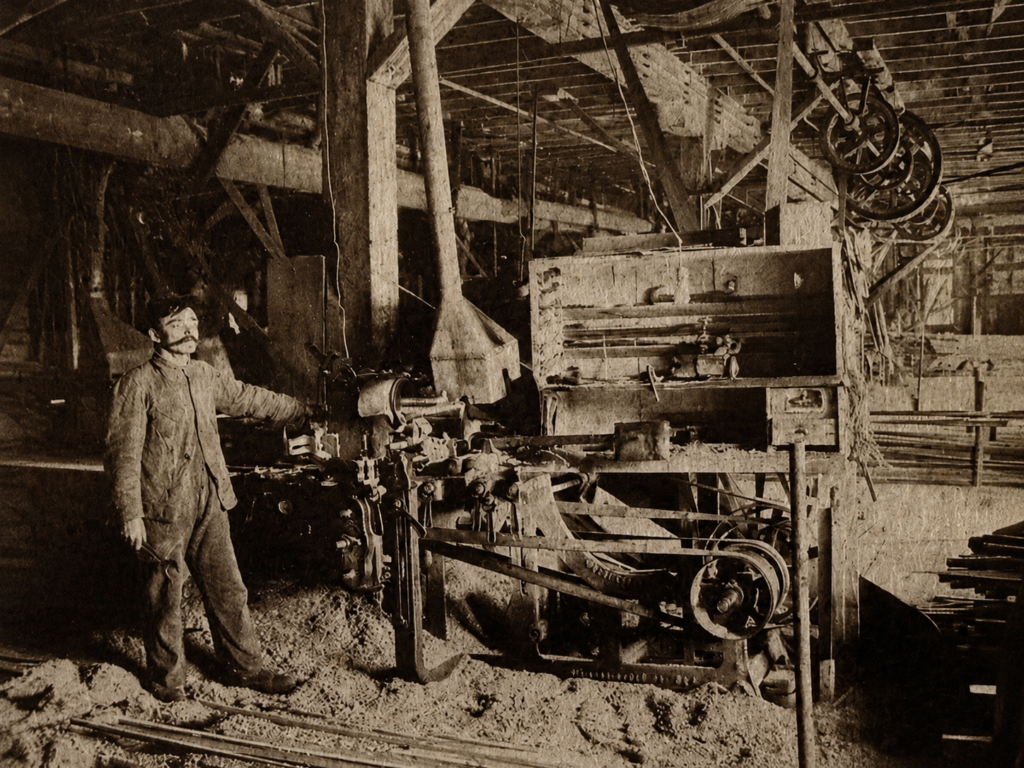
Joseph Lubzinski, father of Jack Lubzinski, at work at a lumber mill in Portland, Oregon — about 1922
Street names reveal our civic and cultural identity. They conjure our history, memorializing stories as they adorn our maps. Most importantly, they can help create community.
The Lubzinski name and Richmond
The name Lubzinski is of Slavic heritage — specifically Polish and Ukrainian — and speaks of the diversity and history of the community, given Jack’s significant contribution to the development of Richmond.
It would therefore be appropriate to express Richmond’s gratitude by naming a road, public building, park or place after Jack Lubzinski. Such a symbolic gesture would honour a deserving Polish-Canadian who performed exceptionally for Canada and, in particular, for the City of Richmond. It would also reflect and preserve Richmond’s multiculturalism.
Every city and town in Canada has pioneers who created their community and paved the way for others. Their stories deserve to adorn public spaces in order to preserve the history and diversity of our communities.
Jack Lubzinski at the time of his graduation from Richmond High School
Early life and immigration to Canada
Jack Lubzinski — photograph by Stefania Gurdowa in Dębica, Poland, about 1926
Jack (James Francis) Lubzinski was born on August 20, 1923, and died on April 11, 2021.
The Lubzinski family was one of the prominent pioneer families of Richmond. They settled on Lulu Island in 1927 and quickly became respected not only among Polish and Ukrainian immigrants, but also among Richmond citizens at large. The family integrated successfully into local society and acquired Canadian nationality rapidly.
Jack Lubzinski was a physicist, inventor, mathematician, entrepreneur, machinist, artist, politician and philanthropist. He was born in southern Poland, in the village of Berezowka, and arrived in Canada at the age of four on June 12, 1927, aboard the R.M.S. Ascania II, an ocean liner operated by the Cunard Line. He appeared on the passenger list under the name “Jacob.” The Ascania played an important role in Canadian immigration history, transporting thousands of passengers on the Liverpool–Halifax route.
A postcard with the passenger liner Ascania. The Lubzinski family was aboard when they came to Canada in 1927.
The Pattullo Bridge model
Jack Lubzinski attended Richmond High School and became known as “the engineering genius of Richmond” at the age of sixteen. He was inspired by the Pattullo Bridge over the Fraser River, which links New Westminster and Surrey. The through-arch bridge was named in honour of Thomas Dufferin Pattullo, the 22nd premier of British Columbia, and opened to traffic on November 15, 1937.
“That bridge changed my life,” Lubzinski later said. It helped him through school, kept him out of the war and launched a lifelong interest in mathematics and physics.
A teacher challenged him to undertake a monumental project. Lubzinski spent approximately eighteen months designing and constructing a scale model of the Pattullo Bridge. Working after school and on weekends in the kitchen and living room of the family home, he reproduced the bridge in extraordinary detail, including the sequence of vertical bars in the outer guardrails. The model stretched more than seven metres and contained roughly 100,000 hand-shaped pieces.
When it was completed, he transported it to school in sections, where it became a showpiece. In 1940, he presented it to Premier Thomas “Duff” Pattullo at the Vancouver Pacific National Exhibition. The model won him a scholarship that allowed him to continue his studies. A court later ruled that Lubzinski’s place was in technology rather than in the army, exempting him from military service.
Jack Lubzinski in a posed newspaper photograph with the model he built of the Pattullo Bridge — 1939
Jack Lubzinski meeting Thomas Dufferin “Duff” Pattullo, the 22nd premier of British Columbia
Education, physics and Ripple Rock
Jack was a consummate student and physicist. He earned a bachelor’s degree in physics from the University of British Columbia in 1947 and a master’s degree in 1950. His thesis was titled “Design and Construction of a Vacuum Spectrograph.” His thirst for knowledge did not stop: over the next forty years he completed more than 360 university courses, including every physics course offered by the British Columbia Institute of Technology.
Before finishing his studies, Lubzinski proposed an innovative solution to the major marine navigational hazard at Ripple Rock in Seymour Narrows. The underwater rock had two peaks that produced large, dangerous eddies in strong tidal currents. Ships often waited until slack tide to pass safely. The eventual solution was a large explosive charge placed beneath the peaks, eliminating the hazard.
Before the historic 5 April 1958 detonation, numerous proposals had been forwarded to Ottawa. One proposed the use of a thermodynamic caisson and was submitted through Kenneth W. Morton, a Canadian public works district engineer at New Westminster, by Jack F. Lubzinski, then a UBC science student. Construction World reported his experimental work in November 1947.
Marine Products Company
Ted Lubzinski’s home in Richmond on No. 2 Road, south of Blundell Road, 1948. Three brothers bought adjoining acre lots and built three houses.
Together with his younger brother Joseph Lubzinski, Jack was involved in the Fraser River and Gulf of Georgia commercial fishing industry and in boat building. In 1951, the Lubzinski brothers created and operated Marine Products Company in Richmond, manufacturing mahogany ship steering wheels that were exported worldwide for more than five decades.
Their wheels were used in British Columbia, by the United States Navy, BC Ferries, luxury liners and customers across the United States, Great Britain, New Zealand, Venezuela and Italy. At the peak of production, the factory produced more than one hundred complete wheels per day.
The Lubzinski brothers designed and constructed the building at 3211 No. 3 Road that housed the manufacturing business and its equipment. The building accommodated a sawmill and foundry, equipment for wood processing and finishing, and a machine shop for welding and burning.
Over his years of manufacturing ship wheels, Jack invented a series of machines and tools that perfected balance and control and significantly reduced the time required to build a wheel. Following the closing of Marine Products Company in 2005, the brothers donated machines, wheels and parts to the Britannia Shipyards National Historic Site. The museum subsequently developed a working exhibit of the ship-wheel manufacturing process.
Marine Products Company’s steering wheels stacked for an advertisement photograph
Ship-wheel components and tools in the Marine Products Company workshop
Lubzinski’s older brothers and boat building
Jack’s three older brothers — Thaddeus, Julius and John — were carpenters and formed a successful dance band. In the late 1930s they became salmon fishermen on the Fraser River and later switched to building fishing boats in Steveston. They studied local boat-building methods, rented a small waterfront shop and began building and equipping their own boats.
At the start of the Second World War, all three enlisted, but two were declined for medical reasons; only the younger brother, John, entered the army. After the war, they resumed fishing and boat building. The quality of their work led other fishermen to commission boats from them. They also built two larger packing vessels used to collect salmon from fishing boats and transport it to canneries.
The brothers eventually opened a boat shop and built larger, more powerful gillnet vessels. Over five years they built ten vessels, two each winter. Thaddeus and John kept the last two boats and continued fishing until retirement.
Launching party for Bob Karliner’s newly built boat Modern Beauty, built by the Lubzinski brothers in Steveston in 1944
Phoenix Cannery fishermen and Fraser River fishery officers at a supper club in December 1950, and the boat Sharon L., built in 1958
Political involvement
In the fall of 1965, Jack Lubzinski was a Social Credit Party candidate in the federal election for Burnaby–Delta–Richmond, receiving 6,999 votes. He ran an intensive campaign that addressed the presence of foreign fishing vessels in waters used by Canadians, the proposed airport on Lulu Island, British Columbia’s trade balance with eastern Canada, the twelve-mile fishing-zone case and the need for a joint conservation program among Pacific nations.
Lubzinski distributed plastic candy bottles to children in Burnaby and Richmond carrying the inscription “Social Credit — your prescription for curing Canada’s ills.” Press articles about his campaign appeared in Alberta, Ontario and Quebec. After the election he received a telegram from British Columbia Premier William Andrew Cecil Bennett.
Jack Lubzinski during his 1965 election campaign
B.C. Premier W. A. C. Bennett’s telegram to Jack Lubzinski after the 1965 election
Retirement, innovation and community engagement
In retirement, Jack divided his time between homes in British Columbia and Point Roberts, Washington. He continued mentoring others in physics, mathematics and invention, worked on the groundbreaking Lubzinski Equation, and helped develop the Lubzinski Center for Innovation (LCFI).
The LCFI, an educational organization, was founded in Point Roberts with assistance from Steve Wolff and Judson Merau. Lubzinski remained active in the Point Roberts community as a ham-radio operator, participant in emergency radio check-ins, facilitator of the CERT trailer, supporter of a community communications antenna project, library fundraiser, community-event sign project and other local initiatives.
The LCFI promotes economic vitality locally and nationally through excellence in mathematics, manufacturing, sustainability and innovation.
Legacy and Polish demographics in Richmond
Jack Lubzinski died at the age of 97 on April 11, 2021. His personal legacy includes a collection of photographs and records preserved in the Richmond Archives under “Lubzinski brothers and Marine Products Company records.”
According to the 2016 Census Profile for Richmond, the city has been home to numerous Poles for several generations. Although the number of residents born in Poland and the number using Polish at home are comparatively low, the number of Richmond residents identifying their ethnic origin as Polish is significantly larger.
Poles living in Richmond and across Canada are an integral part of the country’s cultural mosaic. Richmond offered immigrants from many parts of the world opportunities they did not have in their countries of origin. In return, cultural diversity played an important role in Richmond’s history and in its evolution from an agricultural town into the modern city it is today.
Contributions and achievements
Joseph Lubzinski and members of the local Polish Peasant Party branch in Ropczyce, Poland — about 1920
The Lubzinski name stands out in Richmond’s maritime history. Jack inspired many people in British Columbia and in the Richmond community through his inventions and creativity in physics and mathematics.
Some of his numerous achievements include:
- The Pacific National Exhibition-winning Pattullo Bridge model, built by Jack at sixteen from approximately 100,000 hand-shaped cedar pieces.
- The world-renowned Marine Products Company, manufacturer of high-quality ship steering wheels.
- The Lubzinski Spectrograph.
- The Lubzinski Center for Innovation.
- The groundbreaking Lubzinski Equation.
In June 2013, the giant Pattullo Bridge model was carefully moved from the basement of the New Westminster Museum and Archives, where it had gathered dust for decades. The restored grey wooden model is now displayed as a permanent exhibit at the Anvil Centre.
A proposal to honour Jack Lubzinski
James Francis Lubzinski attained numerous achievements of extraordinary and lasting distinction and made important contributions to Canada, particularly to the City of Richmond. It therefore seems appropriate and compelling to name a road, public building, park or place in his honour.
The proposed naming meets the criteria in Richmond’s naming policies. Adopting the Lubzinski name in public spaces would be a meaningful decision not only for Richmond’s Polish community, but also for Polish Canadians across British Columbia, Manitoba, Saskatchewan and Alberta who helped make Canada the country it is today.
Such commemoration would allow residents to discover a story worth telling repeatedly: how Jack Lubzinski and the Lubzinski family contributed to Richmond’s authentic culture and preserved its diverse and vibrant heritage.
The 35-foot gillnetter Starliner, one of the last two boats built by the Lubzinski brothers in 1963
Photos and acknowledgments
- The City of Richmond Archives — Lubzinski brothers and Marine Products Company fonds
- City of Richmond, Museum and Heritage Services
- Steveston Museum, City of Richmond, B.C. — Britannia Shipyards National Historic Site
- The New Westminster Museum and Archives
- University of British Columbia Library
- Stand By, Let ’Er Go: The Memoirs of a Commercial Fisherman — The Gillnetter Years, by Robert Karliner
- Rahul Kophar’s private collection (photograph by Stefania Gurdowa, Dębica, Poland, about 1926)
Blueprints used in the brochures: James Francis (Jack) Lubzinski, “Design and Construction of a Vacuum Spectrograph,” thesis, Department of Science, Faculty of Physics and Astronomy, University of British Columbia, 1950.
Special thanks to Ms. Sara Skoczylas, the Lubzinski family, Wojciech Mańkowski, Krzysztof Czartoryski, Rahul Khopkar and Izabela Jurczyk.
References
- Press archives (1933–1995): Richmond Review, The Vancouver Sun, The Province, The Times Colonist and The Surrey Leader.
- Richmond Archives: Lubzinski brothers and Marine Products Company records.
- The New Westminster Museum.
- Gary Singh, “Richmond, British Columbia: Where Buddhism Meets Quantum Physics.”
- Obituary — Jack Lubzinski, The Northern Light, April 29, 2021.
- Anne-Fleur Kamst, “World famous ship’s wheel maker passes away,” Richmond News, November 23, 2012.
- Mario Bartel, “Pattullo gets new life at New West museum,” Surrey Now-Leader, June 12, 2013.
- Census Profile, 2016 Census, Richmond, City, British Columbia.